Madhubani Peacock, Fish, Elephant and Bird Motifs
15 designs Madhubani art Updated 9 Oct 2026
The madhubani peacock is the motif my students ask to learn first, and on this page it sits beside fish pairs, elephants, parrots, a tortoise and the tree of life.
All 15 pictures here are original designs, grouped motif by motif. Under every picture you get the materials, the key shapes, a good spot or reader for it and a class tip.
New to the style? Read the overview on our madhubani painting page first, or pick a gentle starter from easy madhubani painting.
Madhubani Peacock Paintings
The peacock is the favourite bird of Mithila painting. Its tail is shown either opened like a fan or trailing long behind, always with a double outline and no empty space inside.
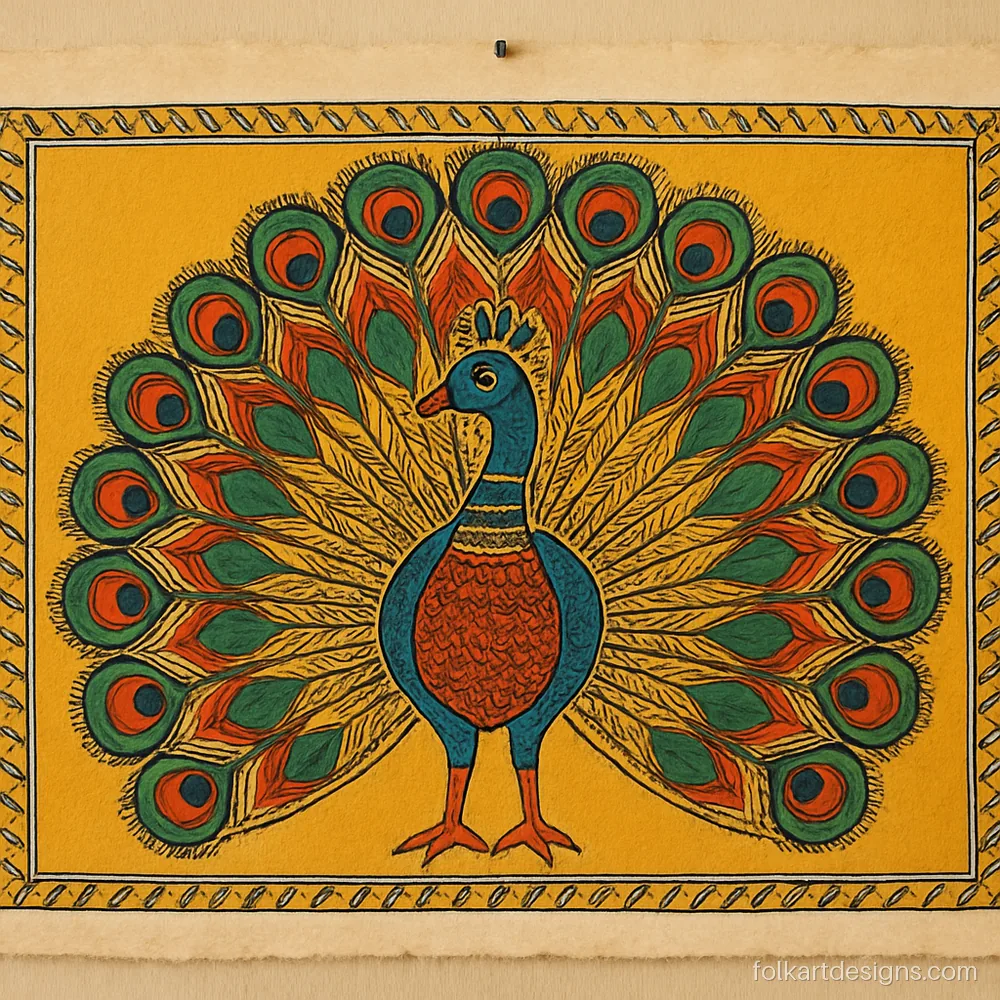
A front-facing peacock with its tail spread wide. Solid red, green and blue fill every feather eye, so it reads clearly from across a room.
Artist tip Draw the tail as one big half circle first, then divide it into feathers with curved pencil lines.
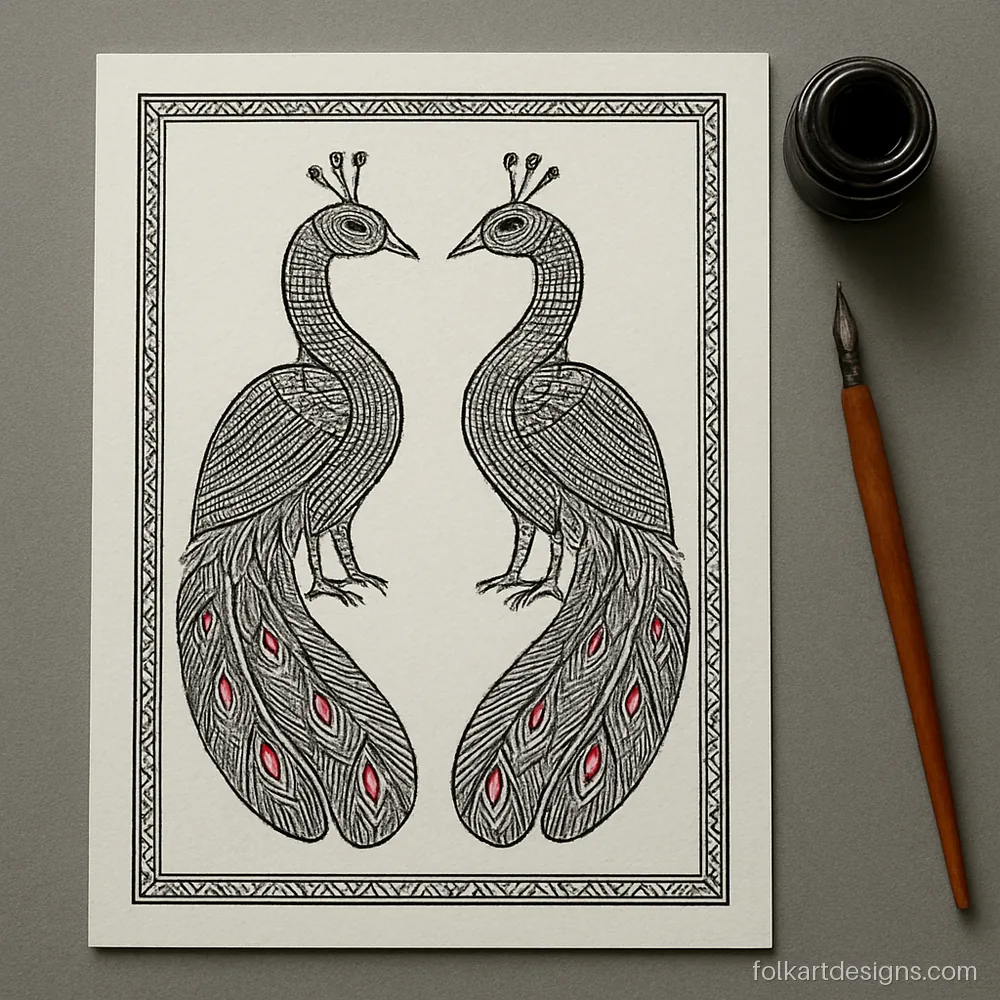
Two peacocks facing each other, drawn only with fine hatching. Kachni needs patience more than talent, and a sheet like this photocopies well for class handouts.
Artist tip Keep the hatching in one direction inside each feather. Changing direction halfway makes the area look untidy.

The peacock and fish together is a classic pairing. A ring of small fish forms the border here, so one canvas holds both favourite motifs.
Artist tip Paint the fish border last. Space the fish with small pencil ticks so they turn the corners evenly.
Madhubani Fish Art: Single Fish, Pairs and Circles
Fish stand for plenty and good fortune in Mithila homes, which is why the famous madhubani painting fish pair turns up on so many walls. This madhubani art of fish moves from a single fish to pairs and circles.
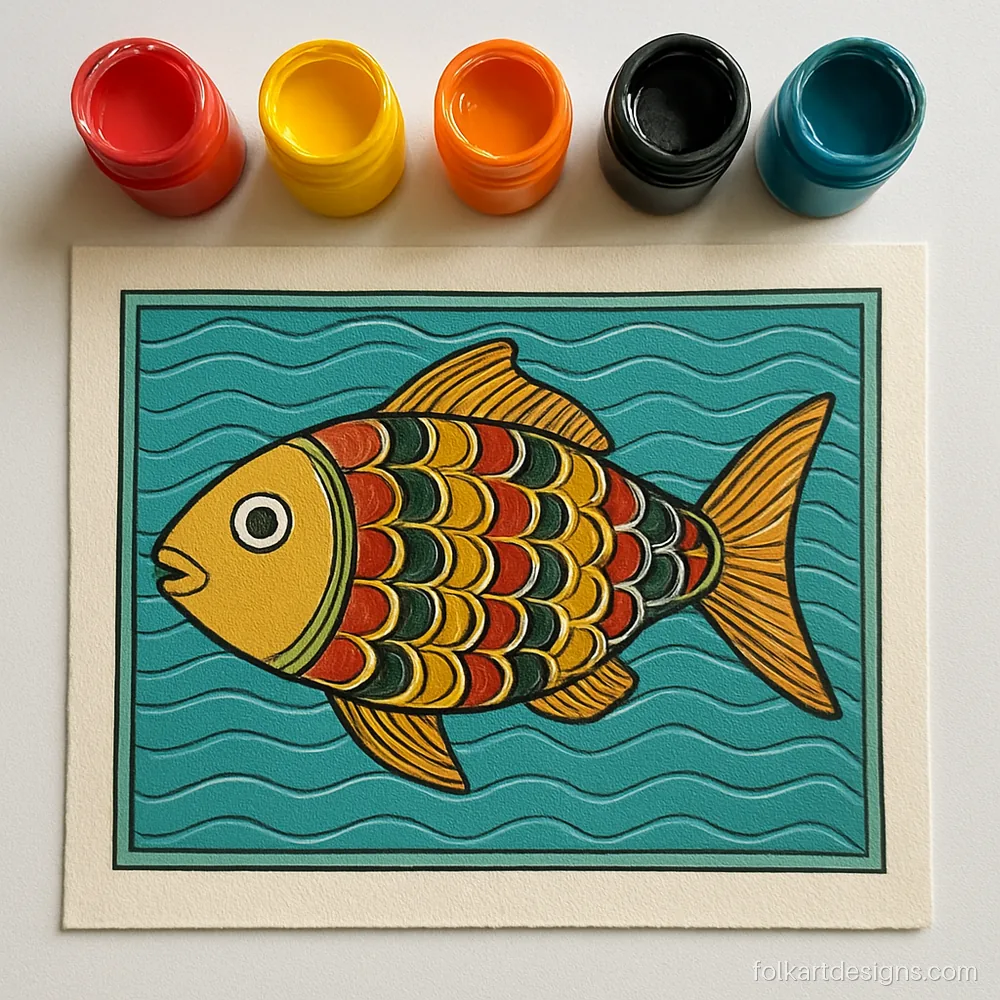
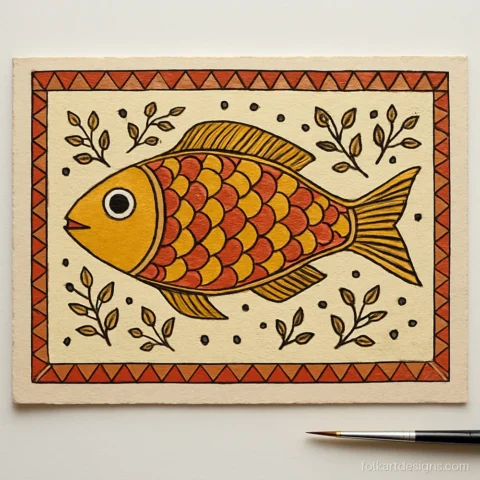
One big fish fills the sheet, its body made of rows of tiny half circles. It is a kind first project because there is only one outline to get right.
Artist tip Draw the scales row by row from head to tail, letting each new row tuck under the last.

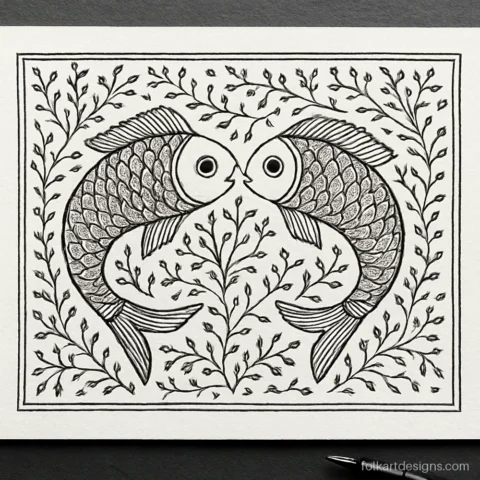
A curved fish pair in black ink only. Without colour every line shows, so this is honest practice, and it looks smart in a plain white mount.
Artist tip Use a 0.5 mm pen for the double outline and a 0.1 mm pen for the hatching inside.
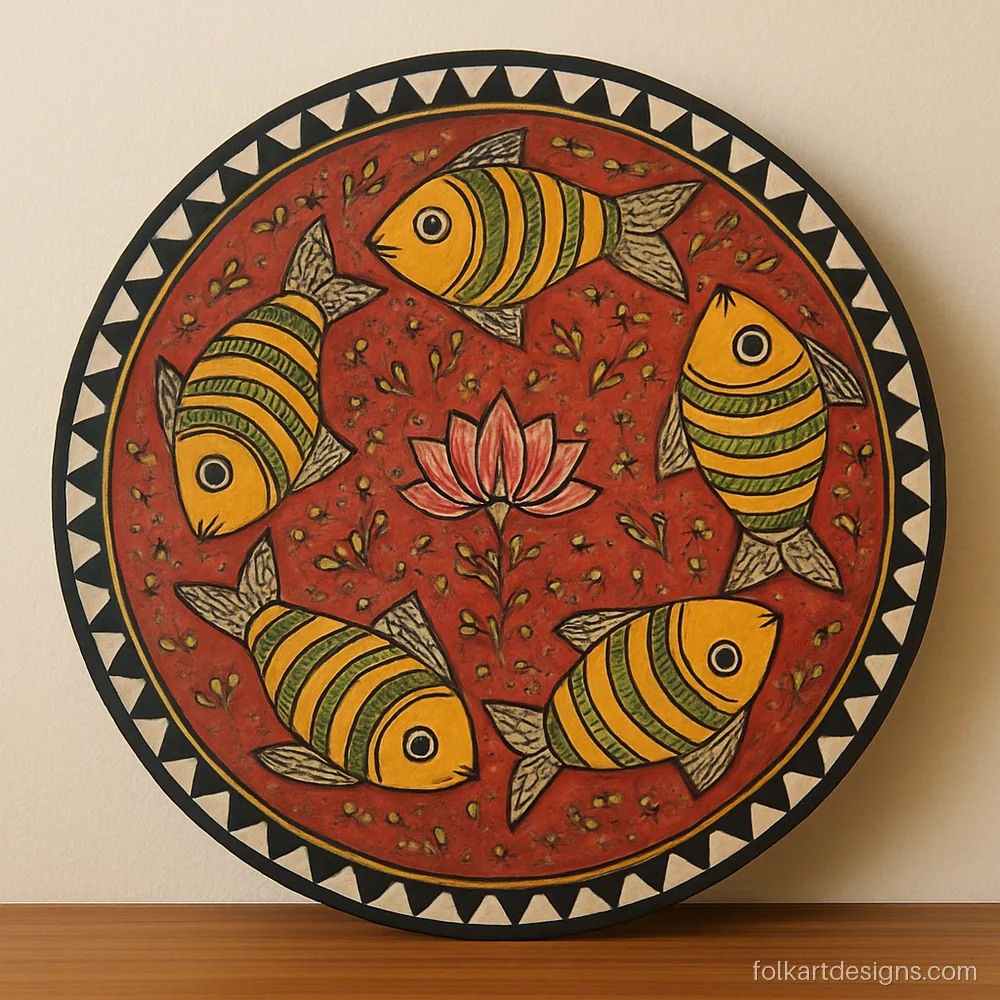
Six fish swim around a lotus like the spokes of a wheel. Circles like this suit round boards, coasters and the centre of a wall panel.
Artist tip Mark six equal points with a protractor, one every 60 degrees, before you draw a single fish.
What Each Madhubani Motif Means
Mithila painting comes from the Mithila region of Bihar, around Madhubani and Darbhanga, and nearby Nepal. Women painted it on mud walls and floors, and today it is done on paper, cloth and canvas. The animals and plants were never chosen at random. Each carries a simple wish for the home.
| Motif | What it usually stands for | Easy way to start |
|---|---|---|
| Peacock | Beauty, love, the rains | A half circle tail on a small oval body |
| Fish, single or pair | Plenty and good luck | Two curved lines meeting at the tail |
| Elephant | Strength and prosperity | A bean shape with four pillar legs |
| Parrot | Companionship | A teardrop body and a hooked beak |
| Tortoise | Long life and patience | An oval shell split into hexagons |
| Tree of life | Growth and family | A trunk with three curling branches |
| Lotus and sun | Freshness and energy | Circles first, petals or rays after |
The same motif changes mood with the style. In bharni it is filled with solid colour, in kachni with fine hatching in one or two colours, and in godna with small repeated marks. For complete compositions built from these motifs, browse madhubani art designs.
Madhubani Painting Elephant Designs, Tortoise and Deer
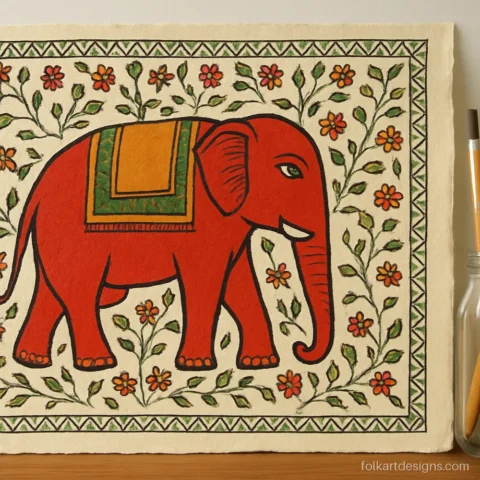
The madhubani elephant is broad and steady, with a patterned back cloth and a curled trunk. Smaller animals like the tortoise and deer can fill gaps in a big scene or stand alone in a simple piece.
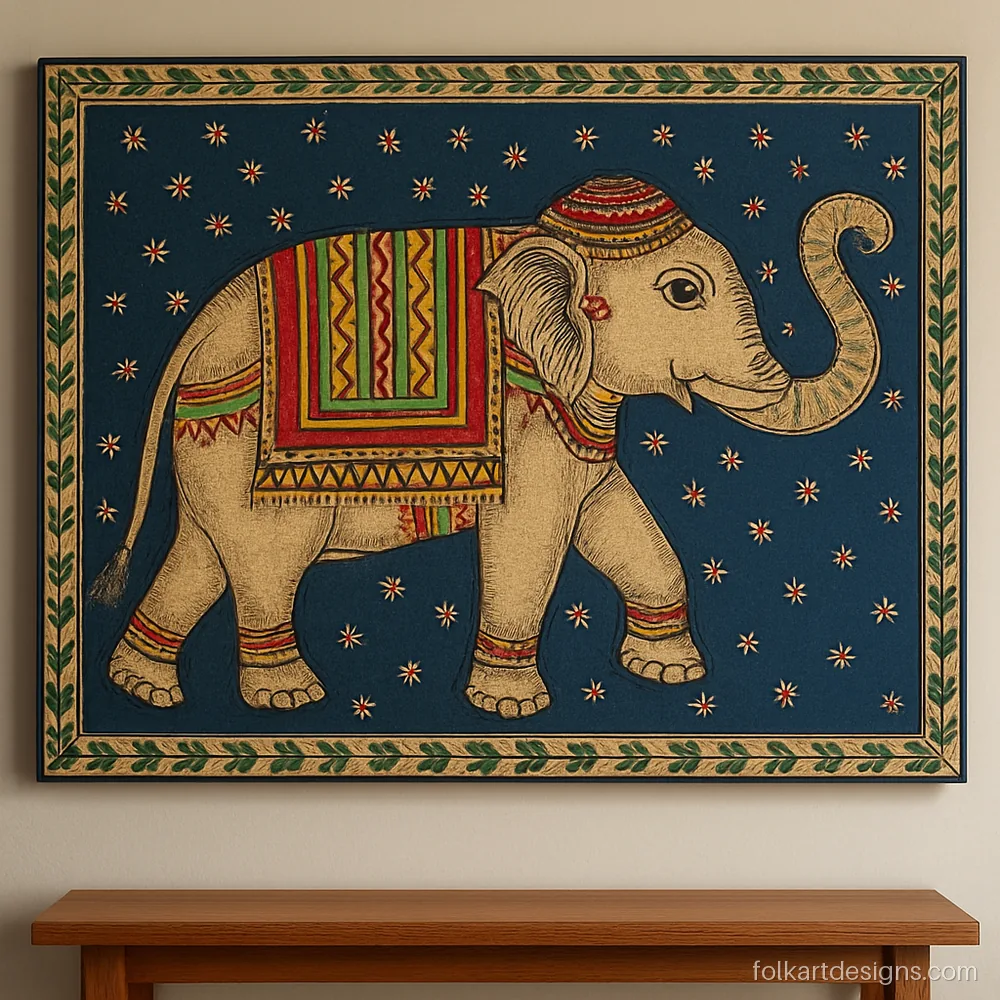
An elephant with a striped, tasselled back cloth. The indigo ground makes the yellow and red stand out, so it fills a large hall or entrance wall well.
Artist tip Draw the body as one large bean shape, then add legs, trunk and ears around it.
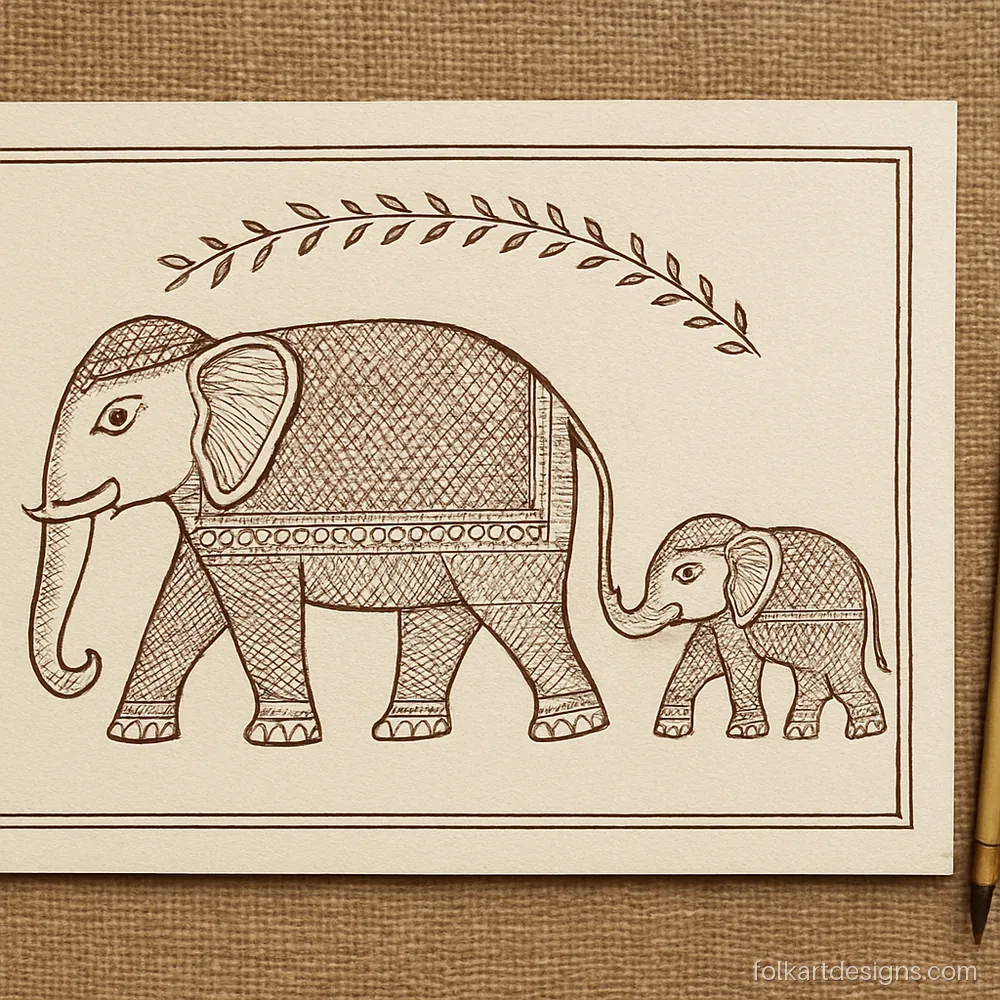
A mother and calf walking in a line, the little one holding her tail. Brown ink on cream paper gives a soft, old look for a nursery or quiet corner.
Artist tip Draw the calf first at about half the height of the mother, then fit the big elephant around it.

A tortoise swims in the pond while a spotted deer stands on the bank. A calm scene for practising two animals with very different shapes.
Artist tip Divide the tortoise shell into hexagons, then fill every second one with small dots.
Madhubani Bird Designs: Parrots, Owls and Sparrows
In madhubani paintings birds are rarely alone. Every madhubani bird has a pointed beak, an almond eye and a tail that turns into a pattern, and parrots usually come in pairs.
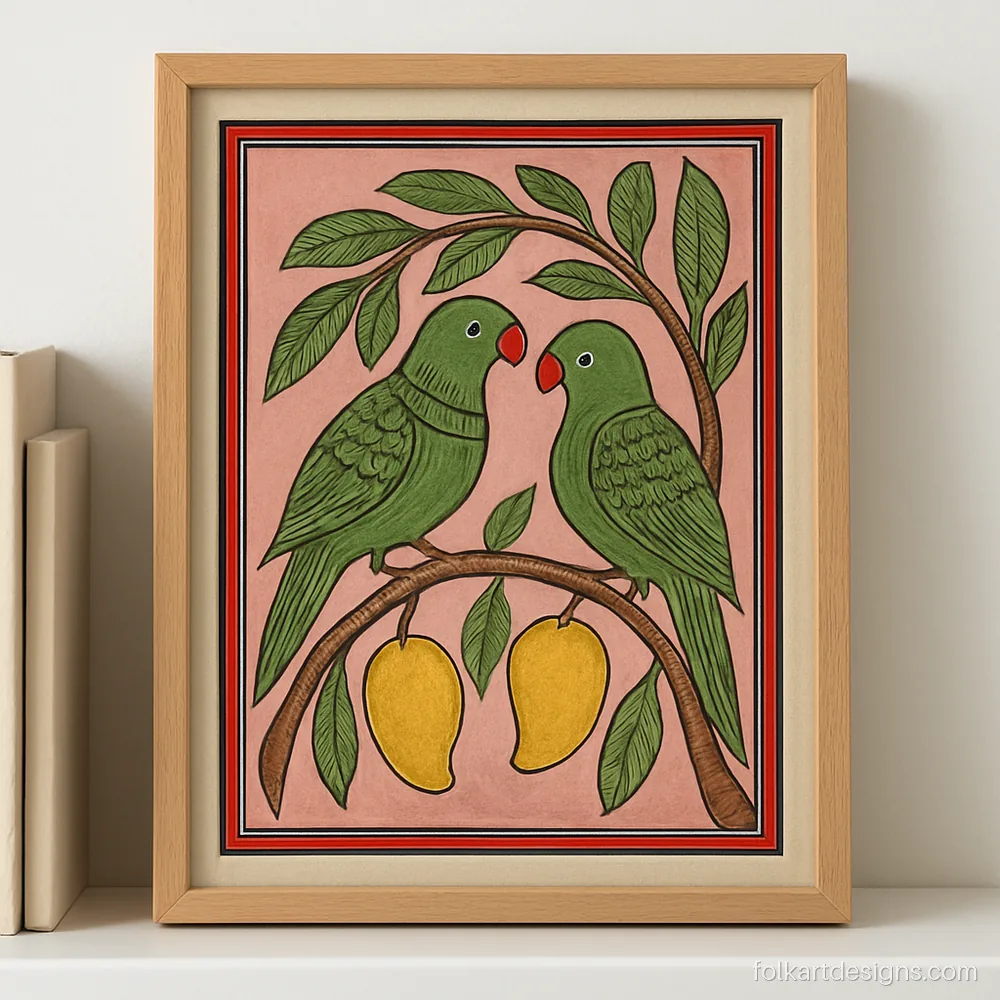
Two green parrots share one mango branch. Parrots are easy to recognise and quick to paint, which makes them good small framed pieces to sell.
Artist tip Add a drop of yellow to the green for the parrots so they stay brighter than the leaves.

This owl keeps its eyes huge and round, as Mithila owls always do. On a black board the white and yellow lines glow, which suits a study or book corner.
Artist tip Trace around a bottle cap for the eye rings. You get clean circles every time.
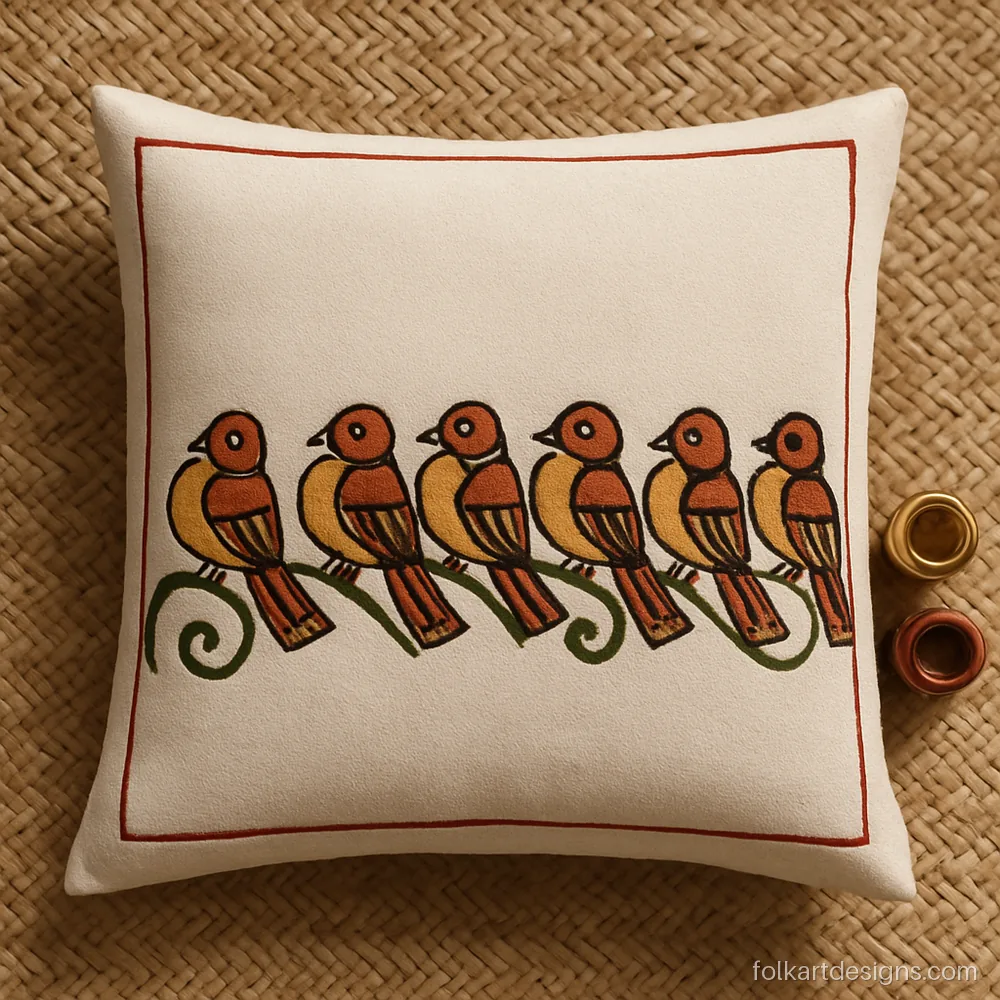
A row of small birds runs along the edge of a cushion cover. Painted textiles like this are a quick craft for gifts or a weekend stall.
Artist tip Slip cardboard inside the cover so paint does not soak through, then iron it after one day to fix colour.
Tree of Life Madhubani Painting, Lotus and Sun
A madhubani painting tree has a thick trunk, branches that curl like vines and creatures gathered around it. Lotus madhubani art and the round sun are the other big nature motifs.
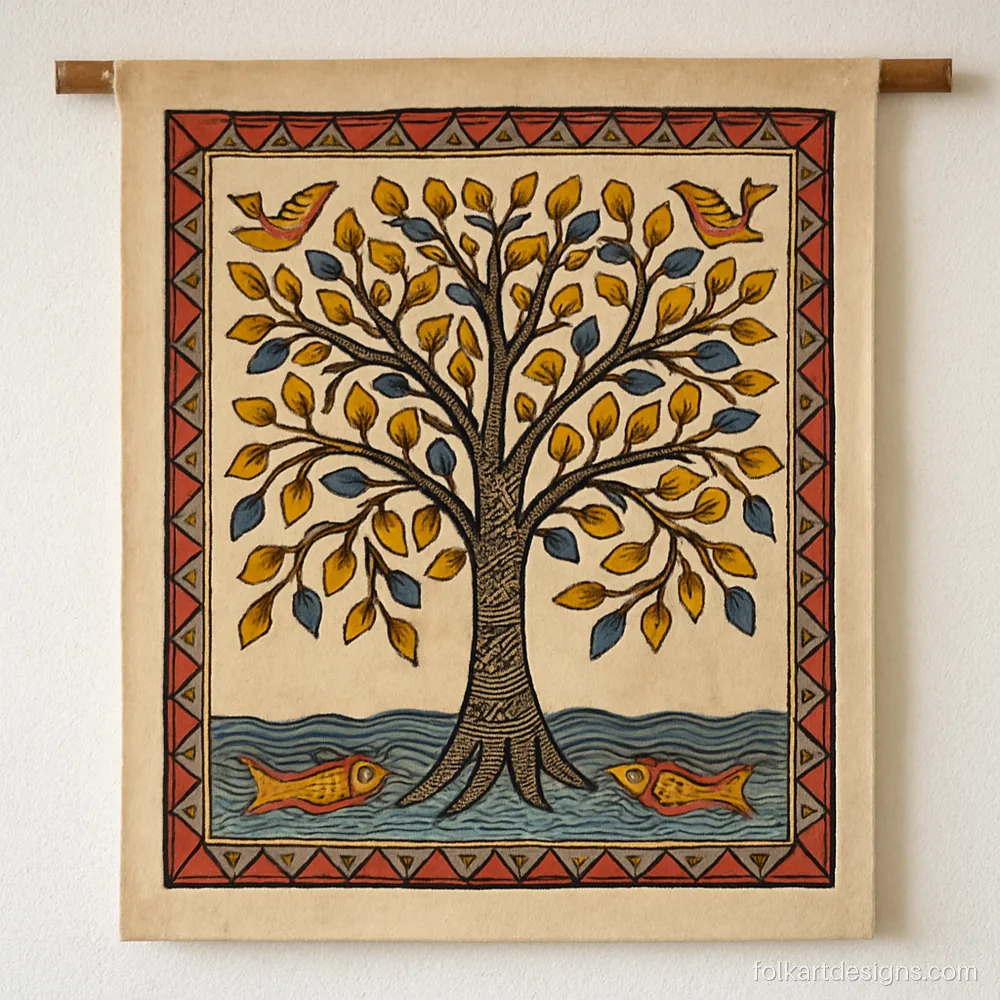
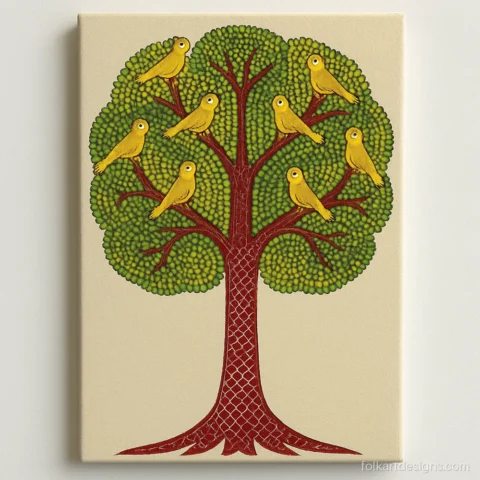
This tree ties the whole page together: birds above, fish below and flowers between. Pick it when you want one large statement piece.
Artist tip Paint the trunk, then branches, then leaves. Add the birds last so they sit in the spaces left.

Madhubani flowers have pointed petals and a double outline. Three open lotuses and their buds make a restful design for a bedroom.
Artist tip Fill each petal in flat pink, then add three short dark lines at its base for depth.
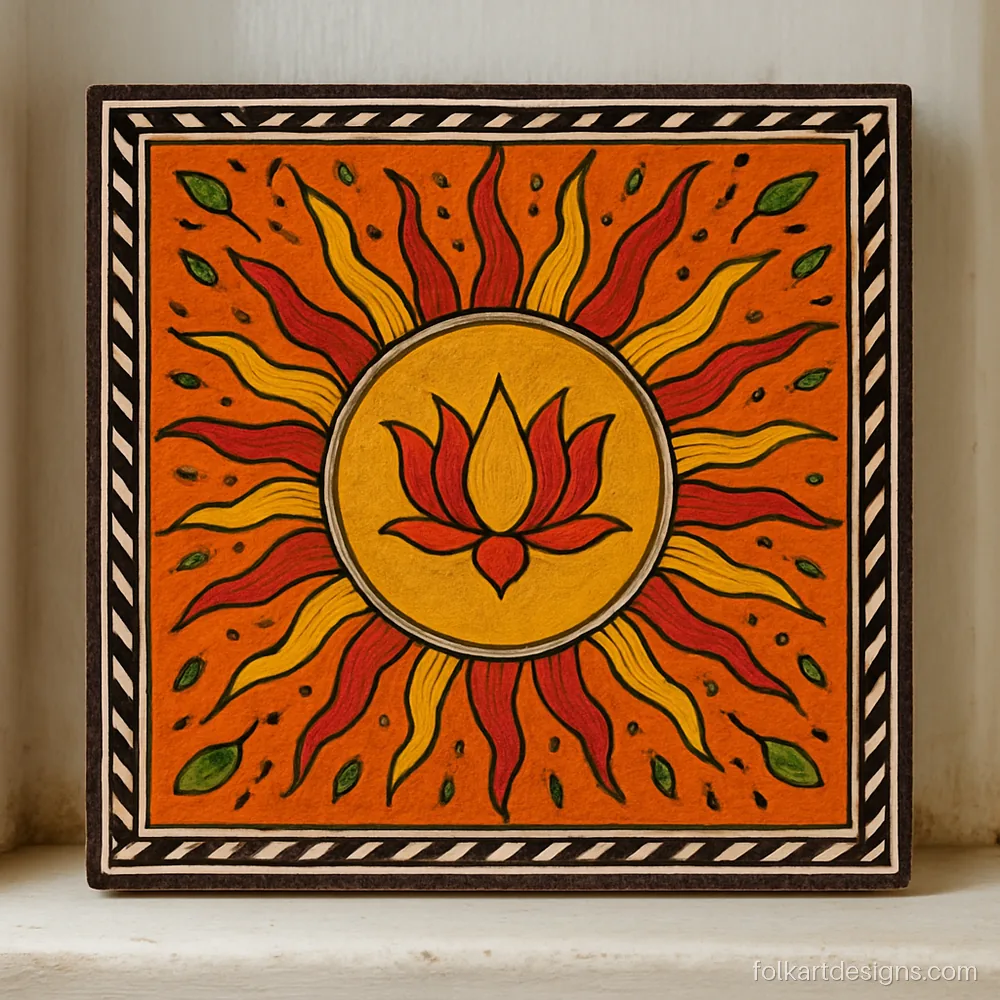
A round sun with wavy rays and a flower at its heart. Sun designs scale up easily for a door panel or down for a bookmark.
Artist tip Use a compass for the inner and outer circles, then draw the rays between them freehand.
How to Paint a Madhubani Peacock Step by Step
- Body: draw a small oval for the body and a smaller circle for the head. Add a thin neck and a crest of three dots on stalks.
- Tail: draw a large half circle behind the body. Split it into 7 to 9 feathers with curved lines.
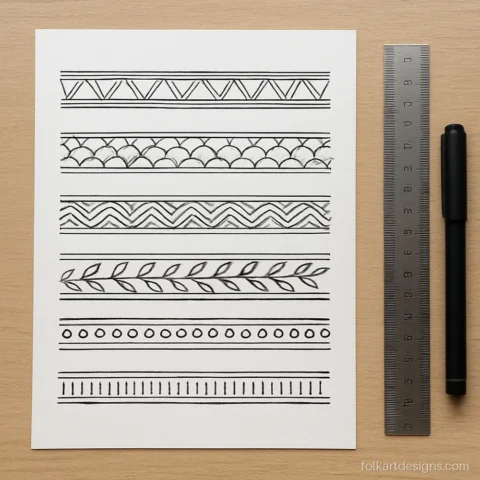
- Double outline: go round every shape twice, about 2 mm apart. This band is where madhubani gets its crisp look.
- Fill: colour the body and feather eyes flat, or hatch them with a 0.1 mm pen for kachni.
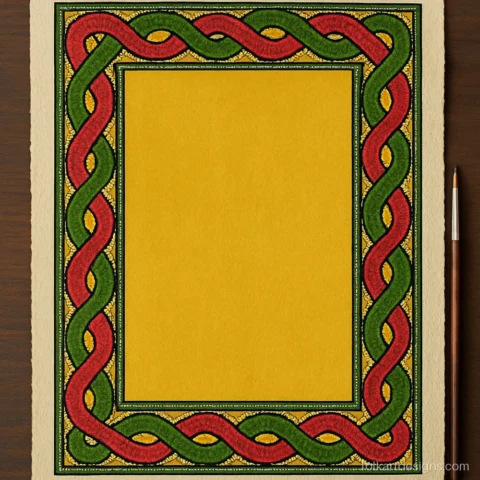
- No empty space: fill the background with leaves, buds and dots, then add a border of repeated triangles or fish.
If you want more line practice, the madhubani drawing page has pen-only exercises.
Colours, Borders and Care
Traditional painters used lamp black, turmeric yellow, indigo and reds from plants and earth, applied with a nib or bamboo stick pen. Acrylic and poster colour are easier for hobby work and dry in 20 to 30 minutes. Leave a 2 cm margin for the border. Frame paper behind glass and roll cloth paintings instead of folding them. Fish and birds are also loved in gond art, a good next style to compare.
Questions about these designs
Why are fish painted in pairs in madhubani art?
A pair of fish stands for plenty, good luck and a happy home. Painters often curve the two fish towards each other so they form a circle. That is why the fish pair is the most recognised fish design in Mithila painting.
What does the peacock mean in madhubani painting?
The peacock stands for beauty, love and the coming of the rains. It is the most painted bird in the style. Many designs pair it with fish or lotus to fill the page.
How do I draw a madhubani elephant easily?
Start with a bean shape for the body, then add four straight legs, a round head and a curled trunk. Fill a rectangular back cloth with stripes and finish with a double outline.
What colours are used for madhubani flowers and birds?
Red, yellow, green, indigo and black are the base colours. Traditional work used natural colours like turmeric and lamp black. Today most people use acrylic, poster colour or fabric paint.
Which state is madhubani painting from?
It is from the Mithila region of Bihar, especially around Madhubani and Darbhanga, and nearby parts of Nepal. That is why it is also called Mithila painting.
Is a madhubani painting fish black and white design traditional?
Yes. The kachni style often uses only black, or black with one colour, and relies on fine hatching. It is a good choice when you have only pens and want a neat, graphic result.